

Why the Right Concrete Foundation Installer Makes All the Difference
Concrete foundation work looks straightforward from the outside — dig, form, pour, done. But the difference between a foundation that performs for fifty years and one that starts showing stress within a decade comes down almost entirely to the people doing the work. Reading engineer drawings accurately, setting up formwork to the correct dimensions and levels, placing and tying reinforcement to specification, achieving the right concrete strength and finish — these aren’t tasks that forgive carelessness or shortcuts.
In Bendigo’s ground conditions, the margin for error is smaller than it is in more stable soil environments. Reactive clay doesn’t accommodate a foundation that’s slightly off — it finds the weakness and works on it, season after season, until the structure above starts telling the story. Our team has installed concrete foundations across Bendigo’s residential and commercial construction sector long enough to know what these soils demand, how to read a soil report, and how to deliver a foundation system that passes inspection, satisfies the engineer, and holds its ground through every central Victorian winter and summer that follows.

Commercial Concrete Foundations Bendigo
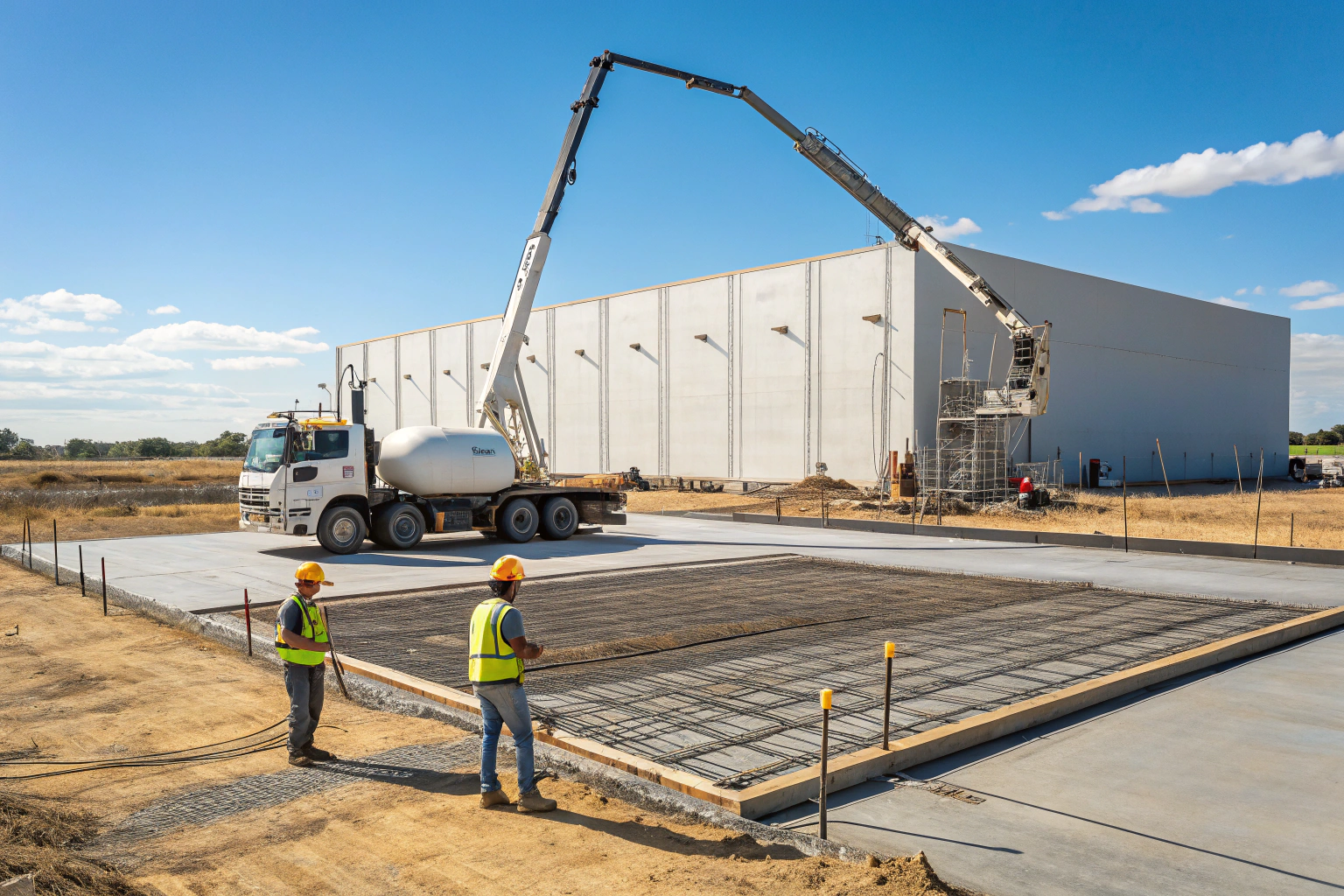
Commercial foundation work in Bendigo operates at a different level of engineering requirement than residential — higher loads, stricter compliance documentation, more complex site conditions, and less margin for deviation from the engineer’s specification at any point in the installation process. Whether it’s a warehouse slab in Kangaroo Flat’s industrial corridor, a retail tenancy foundation in the expanding Bendigo CBD fringe, or a light industrial facility along the Midland Highway, the foundation system has to be designed and installed to carry what’s going above it without movement, settlement, or structural compromise over a commercial asset’s lifespan.
Our team works across light to medium commercial foundation scopes in Bendigo — engaging with the structural engineer’s documentation from the outset, coordinating with the principal contractor on programme and inspection sequencing, and delivering foundation systems that satisfy the building surveyor and hold up under commercial loading conditions. For larger or more complex commercial foundation requirements, head through to our commercial concrete page for a full picture of our capabilities in that space.
Strip Footings vs Pad Footings — Which Does Your Build Need?
The type of footing your foundation requires comes down to the structure above it, the loads it needs to carry, and what the soil report says about the ground beneath. These aren’t decisions made on site — they’re specified by the structural engineer — but understanding the difference helps you follow the documentation and know what to expect during the foundation stage.
Strip footings run continuously beneath load-bearing walls, distributing the weight of the structure evenly along their length. They’re the standard footing type for most residential builds in Bendigo — used beneath brick veneer and double brick construction where the wall line carries the structural load down into the ground.
Pad footings are isolated concrete pads positioned beneath specific point loads — typically steel or timber columns in post-and-beam construction, pergola structures, or commercial framing systems. They’re designed to carry concentrated loads rather than distributed wall loads.
Many builds in Bendigo use a combination of both — strip footings beneath the wall lines and pad footings beneath column or post positions. Our team works to whatever the engineer specifies, installs accurately and is ready for inspection.
Residential Concrete Foundations in Bendigo
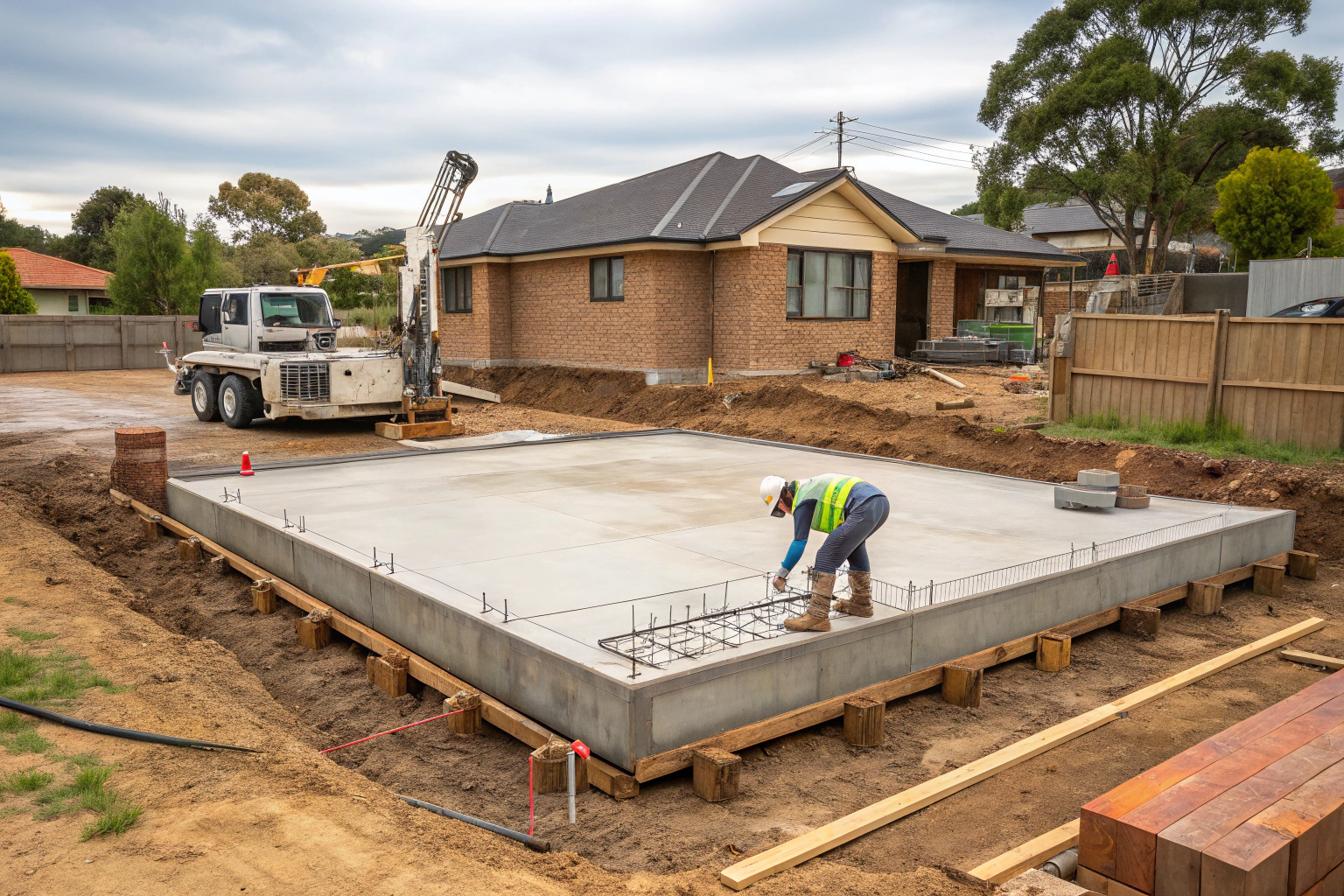
Residential concrete foundation work in Bendigo covers a broad range of scenarios — new home foundations combining engineer-specified footings and slab systems, extension foundations where new work must integrate cleanly with an existing structure, and secondary dwelling foundations where a complete foundation system is required for a new habitable building on an established property. Each scenario carries its own technical requirements, and each one is shaped by the same underlying reality: Bendigo’s reactive clay soils and central Victoria’s seasonal moisture cycles place genuine demands on foundation systems that aren’t designed and installed with that ground behaviour in mind.
Our team works across the full residential foundation scope — from setting out and excavation coordination through to reinforcement placement, pour, and finished slab — delivering systems that meet the structural engineer’s specification, satisfy the building surveyor at inspection, and perform through every season the Bendigo region produces. Head to our concrete footings and house slab pages for more detail on the specific elements within each system.
How Soil Reports Shape Your Foundation Design
Before a structural engineer can specify a single dimension on your foundation drawings, they need to know what the ground is doing beneath the site. That’s what a soil report delivers — a site-specific assessment of the soil type, its reactivity classification, bearing capacity, and moisture behaviour. In Bendigo, where reactive clay soils are common across residential growth areas and established suburbs alike, the soil report findings directly determine how deep the footings go, how robust the slab system needs to be, and what reinforcement specification the engineer will carry through the drawings.
A Bendigo soil report will typically influence your foundation design across several key areas:
- Site classification — ranging from slightly reactive through to highly reactive, which sets the foundation system category
- Footing depth — reactive soils require footings that reach below the zone of moisture influence
- Slab system selection — waffle pod, stiffened raft, or other systems, depending on the classification outcome
- Reinforcement requirements — higher reactivity means more steel, closer spacing, and greater slab thickness
Our team reads soil reports as a standard part of reviewing foundation documentation — understanding what the ground is doing is part of delivering a foundation system that performs in it.
Integrating New Foundations With Existing Structures
Connecting new foundation work to an existing structure is one of the more technically demanding aspects of concrete foundation installation — and one of the most common requirements on Bendigo residential projects. Extensions, secondary dwellings, and garage additions all require new footings and slab work that must sit alongside, or connect directly to, a foundation system that was built years or decades earlier under different conditions and to a different specification.
The challenge is differential movement. The existing foundation has already gone through years of seasonal ground cycles — it’s found its position in the soil. New foundation work hasn’t. Where those two systems meet, the engineer’s specification determines how the connection is handled — tied reinforcement, isolation joints, or a combination approach, depending on the movement risk assessment. Installing that connection accurately is what separates a clean, long-term result from one that starts showing cracking at the junction point within a few years. Our team works to the engineer’s detail at every connection point, on every job.
Sub-Slab Drainage and Foundation Waterproofing
Water is the single most persistent threat to a concrete foundation’s long-term performance — and managing it properly isn’t something that gets addressed after the slab is poured. It’s built into the foundation system before the concrete goes in. Sub-slab drainage, moisture barriers, and correct site drainage are standard considerations on every foundation installation we carry out in Bendigo, not optional extras that get value-engineered out when the budget gets tight.
Beneath the slab, a correctly installed moisture barrier separates the concrete from direct ground contact, reducing the capillary movement of moisture up through the slab over time. Sub-slab drainage systems — where the site conditions or engineer’s specification calls for them — manage water that accumulates beneath the foundation during Bendigo’s wet seasons, preventing the kind of sustained moisture variation that accelerates reactive soil movement and places additional stress on the foundation system above.
Site drainage around the perimeter of the foundation is equally important. Water that pools against the edge of a slab, or runs toward the structure rather than away from it, is working against the foundation every time it rains. Getting the fall and drainage correct at the time of installation is far simpler than dealing with the consequences later.
Frequently Asked Questions
Footing depth in Bendigo is determined by the soil report and the engineer’s specification. On reactive clay sites — which are common across Strathdale, Maiden Gully, and Kangaroo Flat — footings typically need to reach below the active moisture zone, often between 450mm and 600mm or deeper.
Yes, every habitable structure in Victoria requires a site-specific soil report before a structural engineer can produce foundation drawings. The report determines the site classification, which directly drives every dimension and specification in your foundation design.
A house slab is one component of the broader foundation system. The full concrete foundation includes the footing elements that transfer load into the ground, the sub-slab preparation and drainage layer, the moisture barrier, and the slab itself working together as an integrated structural system.
Most residential house slabs in Bendigo are poured in 25MPa or 32MPa concrete. The engineer’s drawings specify the required strength based on your site’s soil report and slab design requirements.
A correctly engineered and poured slab is designed to manage reactive soil movement. The engineer’s specification accounts for your site’s soil classification so the slab bridges ground movement rather than transferring it into the structure above.
Get a Free Quote on Your Bendigo Concrete Foundation Project
The best time to talk to us is early — before the soil report’s been finalised, before the engineer’s drawings are locked, and well before the foundation stage is on the programme. Getting us across your project early means we can review the documentation as it comes together, flag anything that affects the installation approach, and have a detailed, accurate quote ready well ahead of when you need it.
Whether you’re an owner-builder putting together your first new home, a builder pricing a residential extension, or a developer with a commercial project in the pipeline, we’re ready to work through the detail with you. Call us or fill in the quote form and we’ll be in touch promptly.
